
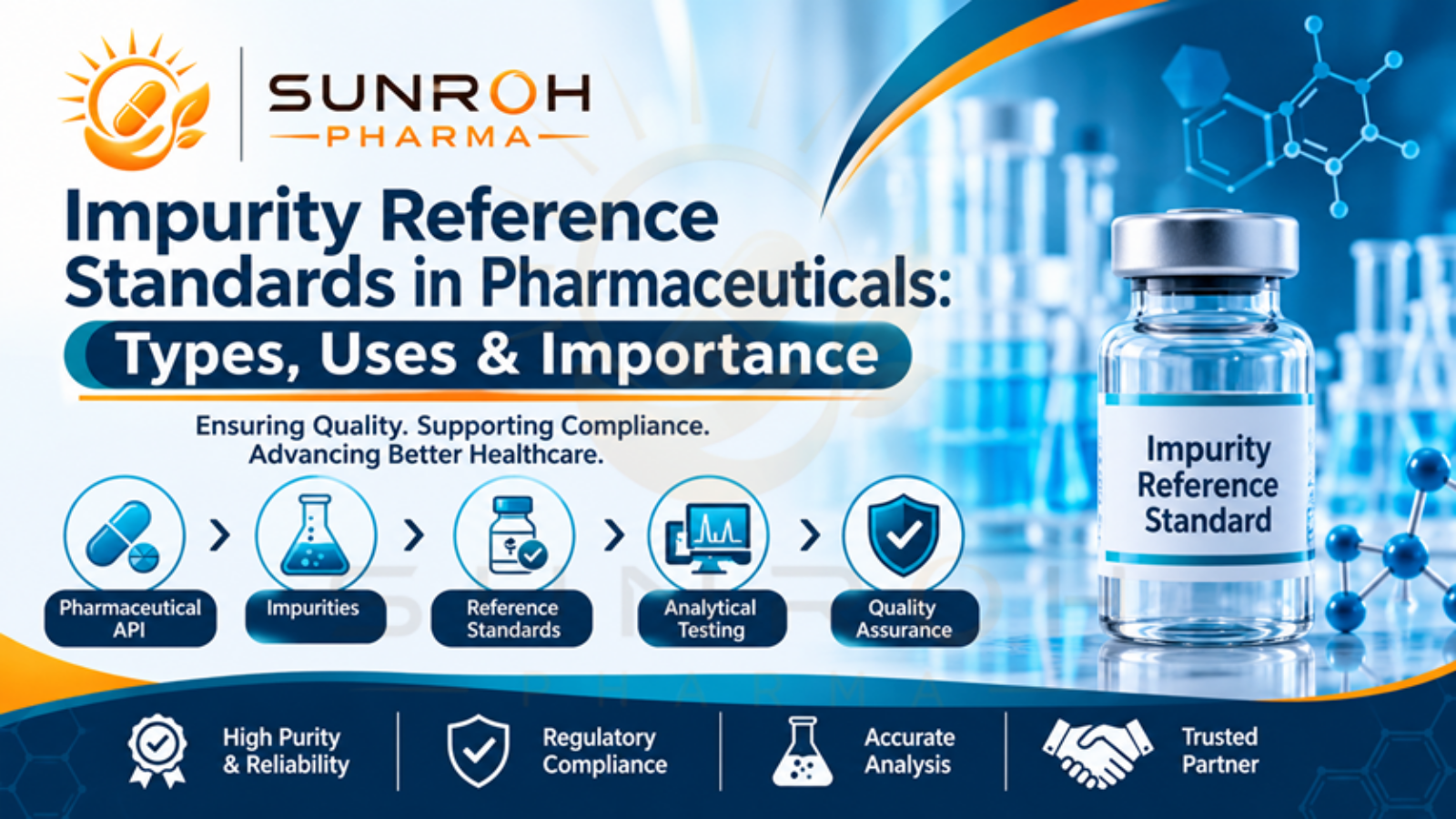
Impurity Reference Standards: An Expert Overview
Understanding pharmaceutical impurity standards, their classifications, analytical applications and importance in pharmaceutical quality control.
Sunroh Pharma
Introduction
Quality and patient safety are fundamental priorities in the pharmaceutical industry. Every pharmaceutical product must comply with stringent quality standards to maintain its safety, efficacy and consistency.
Among the key challenges in pharmaceutical quality control is the accurate detection, identification, characterization and quantification of impurities that may be present in active pharmaceutical ingredients (APIs) and finished drug products.
Impurity Reference Standards are essential tools in pharmaceutical analysis, enabling manufacturers and research laboratories to accurately identify, characterize and quantify impurities while ensuring the reliability and consistency of analytical results.
With a strong commitment to quality and reliability, Sunroh Pharma offers impurity reference standards designed to support pharmaceutical research, analytical method development, quality control activities and applicable regulatory requirements.
How Impurity Reference Standards Support Pharmaceutical Analysis
Identification → Reference → Analysis → Quality
What Are Impurity Reference Standards?
Impurity Reference Standards are highly characterized chemical substances used as reference materials to identify, detect, quantify and control impurities present in pharmaceutical drug substances (APIs) and drug products.
They help ensure that impurities in medicines are within acceptable limits and that pharmaceutical products meet quality, safety and regulatory requirements.
Analytical Techniques
High-Performance Liquid Chromatography
Ultra-Performance Liquid Chromatography
Gas Chromatography
Liquid Chromatography–Mass Spectrometry
Nuclear Magnetic Resonance Spectroscopy
Fourier Transform Infrared Spectroscopy
These reference materials enable analytical scientists to establish impurity profiles, confirm the identity of potential impurities, assess method specificity, support analytical method development and validation, and evaluate impurity levels throughout pharmaceutical development, manufacturing and stability studies.
Types of Pharmaceutical Impurity Standards
Classification of Pharmaceutical Impurities
1. Process-Related Impurities
Process-related impurities are unwanted chemical entities generated during the synthesis and manufacturing of APIs. They may arise from unreacted starting materials, synthetic intermediates, reagents, catalysts, residual solvents, reaction by-products or unintended side reactions.
2. Degradation Impurities
Degradation impurities are formed as a consequence of the chemical or physical instability of pharmaceutical compounds. They may develop through hydrolysis, oxidation, photolysis, thermal decomposition and other chemical transformation processes.
3. Organic Impurities
Organic impurities comprise carbon-containing chemical entities introduced or generated during synthesis, manufacturing, formulation or storage. This category includes starting material residues, synthetic intermediates, reaction by-products, process-related impurities and degradation products.
4. Genotoxic Impurities
Genotoxic impurities are chemical substances that have the potential to cause genetic damage through mechanisms such as DNA interaction or chromosomal alterations. Their assessment requires appropriate toxicological evaluation, sensitive analytical methodologies and scientifically justified risk-based control strategies.
5. Nitrosamine Impurities
Nitrosamine impurities are a class of compounds containing the N-nitroso functional group that may be present in pharmaceutical products as a result of manufacturing-related reactions, contaminated raw materials, recovered solvents or other sources.
Why Are Impurity Reference Standards Important?
Key Applications of Impurity Reference Standards
1. Qualitative Identification and Structural Characterization
Impurity reference standards facilitate the accurate identification and confirmation of suspected impurities by comparing their characteristic analytical properties, chromatographic retention times and spectroscopic profiles.
2. Quantitative Determination of Impurities
Well-characterized impurity standards with appropriately assigned purity values are utilized for the accurate determination of impurity concentrations in pharmaceutical samples.
3. Analytical Method Development and Optimization
They assist in establishing chromatographic separation conditions, evaluating critical analytical parameters and ensuring adequate resolution between the API and its associated impurities.
4. Analytical Method Validation
These reference materials support validation of analytical procedures in accordance with applicable regulatory guidelines, including evaluation of specificity, accuracy, precision, linearity, range and quantitation limits, as relevant.
5. Stability Studies and Degradation Profiling
Impurity reference standards are valuable tools in forced degradation studies and stability-indicating analytical method development, facilitating the identification and monitoring of degradation products.
6. Pharmaceutical Quality Control and Assurance
The use of suitable impurity reference standards strengthens routine quality control activities by enabling systematic monitoring of specified, unspecified and total impurities.
7. Regulatory Compliance and Documentation
Appropriately characterized impurity reference standards provide essential analytical support for pharmaceutical regulatory submissions and quality documentation.
How to Select a Reliable Impurity Reference Standard Supplier?
Appropriate characterization data to establish the identity and quality of reference materials.
Relevant information including chemical name, molecular formula, molecular weight, batch number and purity.
Supporting HPLC, GC, LC-MS, FTIR and NMR data where applicable.
Assigned purity values supported by appropriate analytical procedures and documentation.
Appropriate packaging, handling instructions and storage conditions to maintain quality and stability.
Our Commitment to Pharmaceutical Quality
At Sunroh Pharma, we recognize the critical role of high-quality impurity reference standards in pharmaceutical research, analytical development and quality control.
Our product portfolio and service capabilities are focused on addressing the diverse analytical requirements of pharmaceutical manufacturers, contract research organizations (CROs), research and development laboratories, and quality control facilities.
Our Products and Services
- Pharmaceutical Impurity Reference Standards
- API-Related Impurities
- Process-Related Impurities
- Degradation Impurities
- Working and Analytical Standards
- Custom Impurity Synthesis and Sourcing
- Analytical Characterization and Documentation
At Sunroh Pharma, our approach is driven by a commitment to quality, scientific integrity and customer-focused service. We strive to deliver dependable reference standard solutions, technical support and responsive service to meet the specific analytical needs of our customers.
Looking for Reliable Impurity Reference Standards?
Explore impurity reference standards and analytical solutions from Sunroh Pharma.
Frequently Asked Questions
Q1. What is an impurity reference standard used for?
It is used to identify, characterize and quantify impurities in pharmaceutical drug substances and drug products.
Q2. Which analytical techniques are used to characterize impurity standards?
Common techniques include HPLC, GC, LC-MS, FTIR and NMR.
Q3. What documents should accompany an impurity reference standard?
Depending on the intended application, relevant documents may include a Certificate of Analysis, analytical characterization data, purity assignment details, batch information and storage instructions.
Q4. Can impurity reference standards be used for HPLC method development?
Yes. They can be used to establish retention times, evaluate specificity, prepare reference solutions and assess analytical method performance, depending on their suitability and characterization.
Q5. Why should pharmaceutical companies choose a specialized impurity reference standard supplier?
A specialized supplier can help customers source difficult-to-find impurities, obtain appropriate characterization documentation and meet specific analytical requirements.